
A Rhodes Scholar with a photographic memory failed her McKinsey final round. She could recall every number, every detail, every nuance from the case. The problem? She kept it all in her head.
Twenty minutes into the case, she confused Year 2 growth (15%) with Year 3 growth (12%). That 3% difference flipped her entire recommendation. The interviewer watched her confidence crumble as she tried to mentally backtrack through invisible calculations.
“I never needed notes in school,” she explained later. “I thought taking notes would make me look weak.”
She had it exactly backward.

Your brain during a case interview is juggling seventeen things simultaneously. The client context. The question. Your structure. Multiple data points. Calculations. Hypotheses. Time pressure. Interview dynamics.
Trying to hold everything mentally is like juggling while solving equations. Something will drop.
I’ve watched hundreds of candidates navigate their notes smoothly while others drown in their own scribbles. The difference isn’t intelligence, it’s system.
Your paper isn’t scratch space. It’s mission control. Every piece of information needs a home, and you need to find it in two seconds flat.
Here’s the architecture that works:
Top left: Core question and success metric “Should client enter Brazil? Success = 20% ROI in 3 years”
Top right: Key constraints and context “$50M budget, must maintain US ops, regulatory approval takes 18 months”
Center: Your structure/framework Your logic tree or issue map the spine of your analysis
Left margin: Given facts Revenue: $200M Growth rate: 8% Margin: 15%
Right margin: Calculated insights Market size: $2.5B Accessible share: $400M Required share for ROI: 12%
Bottom: Running hypotheses and next steps “Volume decline driving profit drop, check customer retention next”
Watch how quickly notes become weapons against yourself:
A candidate analyzing a retail chain wrote numbers everywhere. Margins in one corner. Store counts scattered across three pages. Growth rates buried in paragraphs of text.
Interviewer: “What was the northeast region’s growth rate?” Candidate: [Shuffling papers] “Let me find that… I know I wrote it… just a second…”
Thirty seconds of paper shuffling. Credibility evaporating. The number was 7%. The damage was permanent.
Never do math in random corners. Create calculation zones:
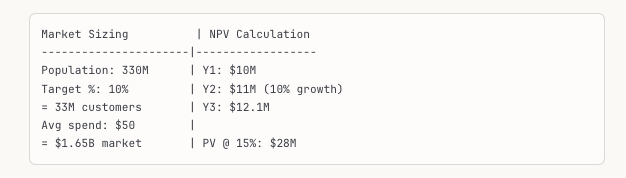
Clean. Findable. Verifiable.
A former NASA engineer transformed her interview performance with one change: she started treating her paper like a control panel. Every metric had coordinates. Every calculation had an address.
Here’s what candidates don’t realize: Taking notes demonstrates strength, not weakness.
When you write “$15M revenue, 20% margin = $3M profit,” you show:
When you mental-math everything, you show:
Which consultant would you hire?
Your notes aren’t just for you. They’re performing for your interviewer.
Bad notes look like this:
15
x3
45
+10
55
What does this mean? No one knows. Including you in five minutes.
Good notes look like this:

Stores: 15
Rev per store: $3M
Total revenue: $45M
Online revenue: $10M
Combined: $55M
Your interviewer can follow your logic without asking. That’s the goal.
When I interviewed candidates at Bain, I could predict offer decisions by minute 10 based on note-taking alone.
Strong candidates had papers that looked like structured dashboards. When I asked follow-up questions, they’d glance down and answer immediately. “Northeast margins were 18%, compared to 15% company average.”
Weak candidates had chaos. Arrows pointing nowhere. Numbers without labels. Calculations bleeding into each other. When asked follow-ups, they’d frantically scan multiple pages or attempt recall from memory.
Poor note systems don’t just hurt accuracy they amplify anxiety.
Every time you can’t find a number, cortisol spikes. Every moment spent searching, confidence drops. Every clarification request sounds like confession of disorganization.
Meanwhile, organized notes create calm. You know where everything lives. You can verify your logic. You can recover from interruptions.
A candidate told me: “Once I fixed my note system, interviews felt 50% easier. Not because the cases were simpler, but because I wasn’t fighting my own documentation.”
Draw your structures the same way every time. Profit trees always branch right. Customer segments always stack vertically. Process flows always move left to right.
This consistency means you don’t waste mental energy remembering where you put things. Your hands know where to write. Your eyes know where to look.
One candidate developed a personal notation system:
“It looked like hieroglyphics,” she said. “But I never lost a data point again.”
Everyone makes mistakes. Good notes enable quick recovery. Mental tracking makes errors fatal.
Interviewer: “I think your calculation is off.”
With notes: “Let me check… I have 1,000 stores times $2M per store… ah, you’re right, it should be $2B not $200M. That changes our market share to 5%.”
Without notes: “Um, let me recalculate everything from the beginning…”
One approach shows professionalism under pressure. The other shows system failure.
Tomorrow, solve a case using strict geographic rules:
Solve three cases this way. By the third, it becomes automatic.
Then add complexity. Multi-page cases. Complex calculations. Time pressure. Your system should hold.
A BCG partner shared this: “When consultants present to boards, they often reference complex analyses conducted weeks ago. The ones who succeed have immaculate documentation. They can resurrect any number, any assumption, any calculation instantly.”
Your interview notes are proving you can do this. Every page shows whether you’ll be trusted with $2 million analyses.
Virtual interviews add complexity. You can’t easily show paper to a webcam. The solution isn’t abandoning notes it’s adapting the system.
Keep the same geography but announce what you’re documenting: “I’m noting that 20% margin figure on the left with our other key metrics.”
This verbal documentation serves two purposes: it helps the interviewer follow along, and it forces you to be even more organized.
I’ve never seen a candidate fail because they took too many notes. I’ve seen dozens fail because they took too few or too chaotic ones.
Your paper is your extended brain. Treat it like a $50,000 piece of analysis, not scratch paper. Because in the interviewer’s mind, that’s exactly what it represents.
Structure your paper like you’d structure a client deliverable. Clear, logical, and navigable under pressure.
That’s not just good interview technique. That’s consulting.
Get coached the way MBB consultants practice. Book a free intro call with my team today, and build the clarity, structure, and confidence that win offers.
Good luck and enjoy the ride!
As a coach with consulting experience, I can provide you with more tips and one-on-one practice to sharpen your estimation techniques. Book a intro session with my team to know more.
